
Think of the last time you spotted a vintage car gleaming at a summer show on Herne Bay seafront. Fifty years old, still on the road, still turning heads. Somewhere along the way, someone looked after it properly, fixed what needed fixing and gave it a fresh coat when the old one wore thin.
Your teeth deserve the same kind of care. Life has a habit of chipping, cracking and wearing them down, whether it’s an old filling that’s done its time, a surprise olive stone or simply decades of happy chewing.
That’s where a dental crown comes in. It’s one of the most reliable tools in modern dentistry, and very often the reason a tired tooth gets a second lease of life rather than an early retirement.
If your dentist has mentioned a crown, or you’re simply curious, this guide walks you through everything in plain English: what a crown is, the different types, what actually happens in the chair and how long you can expect yours to last.
What is a dental crown?
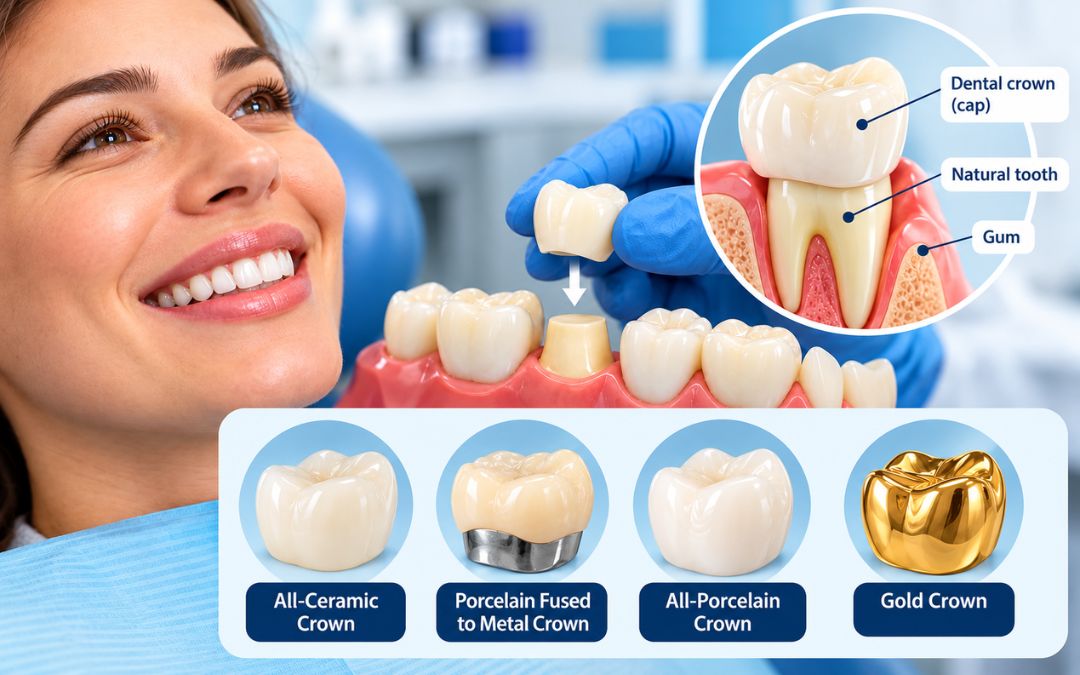
A dental crown is a custom-made cap that fits snugly over a tooth, covering it completely above the gum line. Once it’s fixed in place, it restores the tooth’s shape, strength and appearance.
A helpful way to picture it is a protective helmet for your tooth. The natural root stays exactly where it is, doing its job, while the crown takes over the hard work of biting and chewing. Done well, nobody will ever know it’s there.
Crowns are also sometimes called “caps”, so if you’ve heard both words, they mean the same thing.
When might you need a crown?
Crowns are usually recommended when a tooth needs more support than a filling can give. Common reasons include:
- A large or failing filling, where there isn’t much natural tooth left to hold a new one
- A cracked or broken tooth, to hold it together and stop the crack spreading
- After root canal treatment, as treated back teeth can become more brittle
- Heavily worn teeth, often from grinding or clenching
- A discoloured or misshapen tooth that whitening or bonding can’t fix
- Supporting a bridge or covering a dental implant, to replace missing teeth
In short, a crown is often what stands between keeping your natural tooth and losing it. That’s a pretty good reason to feel positive about one.
The main types of dental crown
Not all crowns are made the same. The right choice depends on where the tooth sits in your mouth, how hard it works and how much the look matters to you.
| Crown type | Looks | Strength | Often used for |
|---|---|---|---|
| All-ceramic (e.g. zirconia, e.max) | Very natural, metal-free | Strong | Front and back teeth |
| Porcelain bonded to metal | Natural, but a thin dark line may show at the gum over time | Very strong | Back teeth and bridges |
| All-porcelain | The most lifelike | Less strong | Front teeth with lighter bite forces |
| Gold or metal alloy | Clearly metallic | Extremely durable | Back teeth that are rarely seen |
All-ceramic crowns are the most popular choice today. Modern ceramics such as zirconia combine real strength with a natural, light-reflecting finish, so they work almost anywhere in the mouth.
Porcelain bonded to metal crowns have been a dependable option for decades. A metal core gives strength, and porcelain on top matches your other teeth.
Gold crowns might sound old-fashioned, but they’re remarkably hard-wearing and gentle on the opposing teeth. Some patients still choose them for molars at the very back.
Your dentist will talk you through the options and help you weigh up looks, strength and cost for your particular tooth.
What happens when you have a crown fitted?
Getting a crown usually takes two appointments, a couple of weeks apart. Here’s what to expect, with no surprises.
Visit 1: Preparing the tooth
- A check and a chat. Your dentist examines the tooth, often takes an X-ray, and explains exactly what’s planned.
- Getting comfortable. A local anaesthetic numbs the area, just like having a filling. If you feel anxious, let us know and we’ll go at your pace.
- Shaping the tooth. A thin layer is gently removed from the outside of the tooth, so the crown can sit neatly over it without looking bulky.
- Taking a mold or scan. Your dentist records the exact shape of your prepared tooth and its neighbours. Together you’ll also choose a shade that matches your smile.
- A temporary crown. A temporary cap goes on to protect the tooth while your permanent crown is handmade in a dental laboratory.
Visit 2: Fitting your new crown
- The temporary crown comes off.
- Your dentist tries on the new crown, checking the fit, colour and your bite.
- Once you’re both happy, it’s cemented firmly in place.
That’s it. Most people head straight back to work afterwards, and within a few days the crown simply feels like one of your own teeth.
How long do dental crowns last?
With good care, many crowns last 10 to 15 years, and plenty go on for much longer. Like that vintage car, the secret is regular maintenance rather than luck.
A few things affect how long yours will last:
- Your daily cleaning routine. The crown itself can’t decay, but the natural tooth underneath still can, especially at the edge where the crown meets gum.
- Grinding or clenching. Night-time grinding puts huge pressure on crowns. A custom night guard can protect your investment.
- Habits. Chewing ice, biting pens or opening packets with your teeth are best left behind.
- The material and position. Back teeth work harder than front teeth, which is why stronger materials are often chosen for them.
Simple ways to help your crown go the distance
- Brush twice a day for two minutes with fluoride toothpaste
- Clean between your teeth daily with floss or interdental brushes
- Keep sugary snacks and drinks to mealtimes
- Keep up regular check-ups and hygienist visits, so small issues are caught early
Crown, filling or veneer: what’s the difference?
These three often get muddled, so here’s the quick version:
- A filling repairs a smaller cavity or chip. It’s the simplest fix when plenty of healthy teeth remain.
- A veneer is a thin shell bonded to the front of a tooth. It’s mainly cosmetic, used to improve colour or shape.
- A crown covers the whole tooth. It’s chosen when the tooth needs strength and protection, not just a cosmetic touch-up.
A good dentist will always suggest the least invasive option that will genuinely last. If a filling or bonding will do the job, that’s what you’ll hear.
Frequently asked questions
Does getting a crown hurt?
No. The tooth is numbed with a local anaesthetic, so you’ll feel some pressure but not pain. It may feel a little tender for a day or two afterwards.
How long does it take to get a crown?
Usually two appointments around two weeks apart, while the laboratory makes your crown. Each visit typically takes under an hour.
Can I eat normally with a temporary crown?
Mostly, yes. Just avoid very sticky or hard foods, and chew on the other side where you can, until your permanent crown is fitted.
Will my crown look natural?
Yes. Modern ceramic crowns are shade-matched to your own teeth, so they blend in beautifully.
What happens if a crown comes off?
Keep it safe, avoid chewing on that side and call your dentist. In many cases it can simply be cleaned and re-cemented.
Give your tooth its second lease of life
A dental crown isn’t a sign that something has gone badly wrong. It’s a clever, well-proven way to protect a tooth you’d rather keep, and to keep you smiling and chewing comfortably for years to come.
If you’ve got a cracked, worn or heavily filled tooth, or your dentist has mentioned a crown and you’d like a second opinion, our friendly team in Herne Bay is happy to help. We’ll explain your options clearly, with no pressure. Call us on 01227 375 592 or request your free consultation online.
This article is for general information and doesn’t replace a personal examination. Please speak to your dentist about what’s right for your teeth.