
Tooth loss can happen because of gum disease, tooth decay, or trauma. Replacing a missing tooth can reduce your risk of future oral health issues like shifting of teeth and further tooth loss.
Once you decide to act, you have some important decisions to make. Two treatments consistently come up as solutions: dental bridges and dental implants. Both restore your smile and your bite, and both are fixed in place but despite these similarities, they work very differently, last very differently, and affect your long-term oral health in ways that are worth understanding before you choose.
This guide covers both options honestly, including when a bridge makes more sense than an implant, so you can decide which one works better for your situation
What Is a Dental Implant?
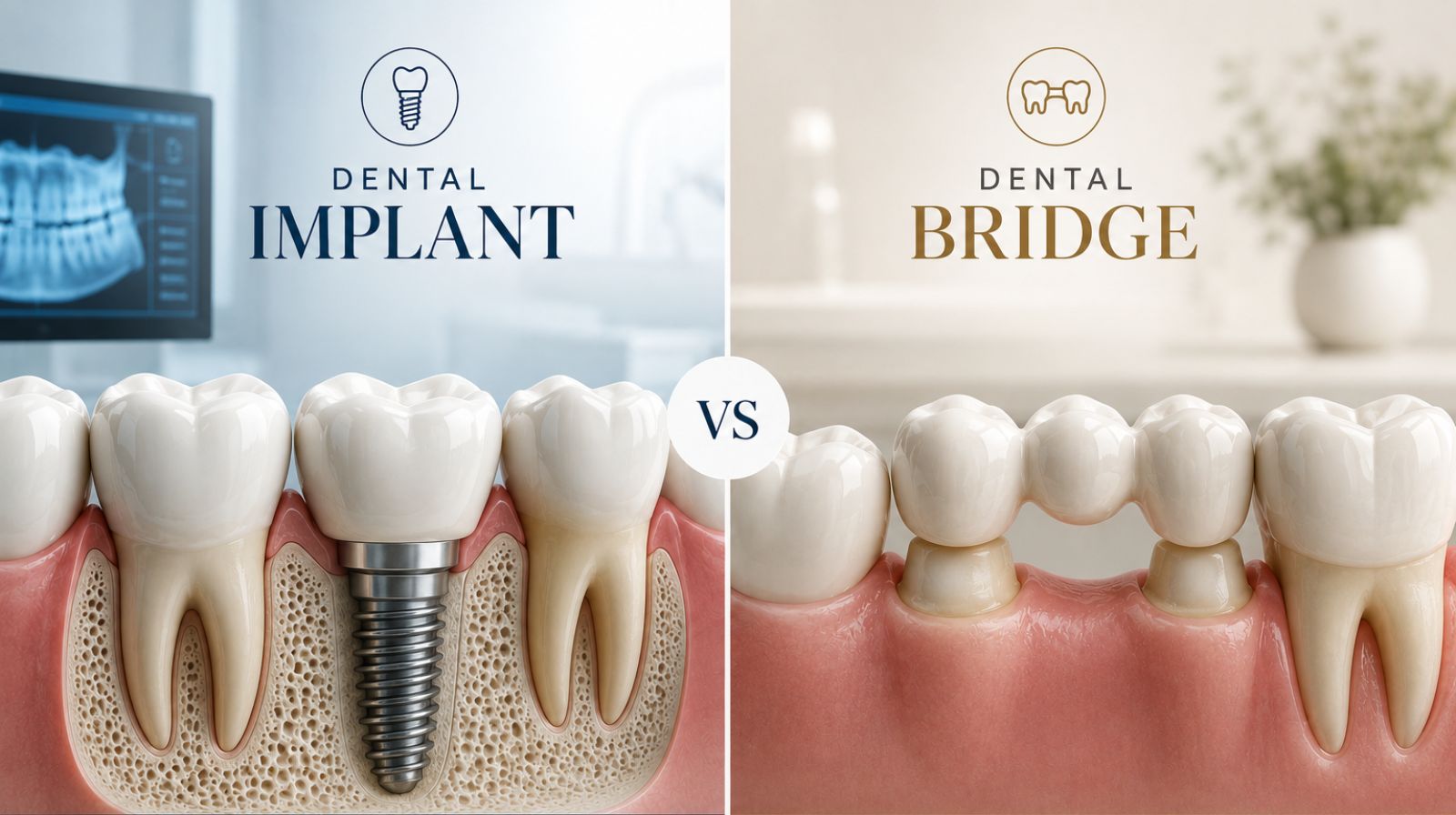
A dental implant is a small titanium post that is placed directly into the jawbone to act as an artificial tooth root. Once the post has bonded with the bone, a custom-made crown is attached on top to restore the visible part of the tooth. Once fully integrated, implants function just like your natural teeth.
Components of a Dental Implant
Titanium Post – A titanium post surgically placed into the jawbone to act as an artificial tooth root.
Abutment – A small connector piece that sits on top of the titanium post, linking it to the crown above.
Crown – Custom-made to match your surrounding teeth, the crown fits on top of the abutment to replicate the look and function of a natural tooth.
The Dental Implant Procedure: Step by Step
Initial Consultation – Your dentist assesses your oral health and bone density to determine whether you are a suitable candidate for implant treatment.
Implant Placement – The titanium post is surgically placed into the jawbone under local anaesthetic.
Osseointegration – The post is left to bond naturally with the surrounding bone over three to six months.
Abutment Fitting – Once fully integrated, the abutment is attached to the post to prepare it for the crown.
Crown Placement – The custom-made crown is fitted onto the abutment, completing the restoration.
What is Dental Bridge?
A dental bridge is a fixed restoration used to replace one or more missing teeth by literally “bridging” the gap with an artificial tooth, known as a pontic. The bridge is anchored onto the neighbouring healthy teeth using crowns. Once fitted, a bridge is permanent, it does not come in and out like a denture.
Types of Dental Bridges
Traditional Bridge – Supported by crowns placed on the neighbouring teeth on either side of the gap, with an artificial tooth suspended in the middle.
Cantilever Bridge – Attached to just one neighbouring tooth, making it suitable where only one natural tooth sits beside the gap.
Maryland Bridge – Held in place using metal or porcelain wings that bond to the back of the adjacent teeth, leaving them largely intact.
The Dental Bridge Procedure: Step by Step
Initial Consultation – Your dentist examines your teeth and assesses the gap to determine whether a bridge is the right treatment for you.
Tooth Preparation – The neighbouring teeth are filed down slightly to make room for the crowns that will anchor the bridge in place.
Impressions – Detailed impressions of your teeth are taken and sent to a laboratory where your permanent bridge is custom-made.
Temporary Bridge – A temporary bridge is fitted to protect the prepared teeth while your permanent one is being made.
Permanent Bridge Fitting – Once ready, the permanent bridge is placed, adjusted for fit and bite, and cemented firmly into position.
How to Choose Between a Dental Bridge and a Dental Implant
These are the key factors to consider when deciding between a dental bridge and a dental implant, so you can choose the option that works best for your situation.
1. Treatment Timeline
A dental bridge requires no surgery. Your dentist prepares the neighbouring teeth by filing them down slightly, takes impressions of your mouth, and fits a temporary bridge while your permanent one is being made. Once ready, the permanent bridge is cemented firmly into place. The whole process takes just two to three appointments over three to four weeks.
Placing a dental implant requires some patience, as it involves a minor surgical procedure. A small titanium post is placed directly into the jawbone where the missing tooth once was. After placement, the post is left to bond with the bone over three to six months before the final crown is attached.
For many patients, the time difference between both procedures can be a deciding factor.
2. Cost Comparison
Cost is often the first thing patients consider when choosing between a dental bridge and a dental implant. A dental bridge starts from £750 and can go up to £1,500 for a single tooth replacement, while a dental implant typically ranges from £2,000 to £3,000.
Although the upfront cost of an implant is higher, it is important to consider the long-term value. Bridges usually last between 5 and 15 years before needing replacement, whereas an implant, including a crown replacement if required, is estimated to cost around £2,700 to £4,000 over 25 years.
It is also worth reviewing your dental insurance policy before deciding on treatment. Most plans contribute towards the cost of a bridge, as it is considered a standard restorative procedure. Implant cover varies considerably between providers, so checking your policy in advance is always recommended.
3. Maintenance and Cleaning
Implants are the easier option to maintain long term. You brush and floss around them exactly as you would a natural tooth, making them straightforward to keep clean as part of your normal daily routine.
Cleaning a bridge requires a little more effort. Because the artificial tooth sits on top of the gum rather than being rooted in it, food particles can become trapped underneath. Keeping the area clean requires special tools such as floss threaders or interdental brushes to clean effectively beneath the bridge.
4. Number of missing teeth
If you are missing more than one consecutive tooth, a bridge can be a practical and affordable solution, spanning the gap with a single fixed structure and helping to prevent further dental issues down the line.
With implants, each missing tooth typically requires its own individual post to be surgically placed into the jawbone. For multiple missing teeth, this can make the process more time-consuming, more complex, and considerably more expensive. In this situation, All-on-4 implants offer a more suitable alternative, using just four strategically positioned implants to support a full fixed arch of teeth.
5. Bone Density
Bone density is an important factor that your dentist will assess before recommending either treatment. If significant bone loss has already occurred at the site of the missing tooth, there may not be sufficient bone for an implant post to anchor securely into the jawbone. In this case, a dental bridge is often the more appropriate option, as it does not rely on the jawbone for support.
If you have adequate bone density, a dental implant is a strong choice. Because an implant is placed directly into the jawbone, it acts in the same way as a natural tooth root, stimulating the bone and preventing further deterioration over time. This helps maintain the structure of your jaw and preserves your facial shape in the long term
Conclusion
Ultimately, the decision between a dental bridge and a dental implant comes down to your personal circumstances, your oral health and your budget. If you are looking for a quicker, more affordable solution, a bridge can be an excellent choice. If you are ready to invest in a permanent, natural-looking result that lasts a lifetime, an implant is likely the better option for you.
What matters most is that you decide with the right information and the right guidance. Every patient is different, and the best treatment for you depends on factors that can only be properly assessed in a clinical setting.
At Warwick Lodge Dental and Implant Centre in Herne Bay, our experienced team will walk you through your options honestly and help you reach a decision you feel confident about.