
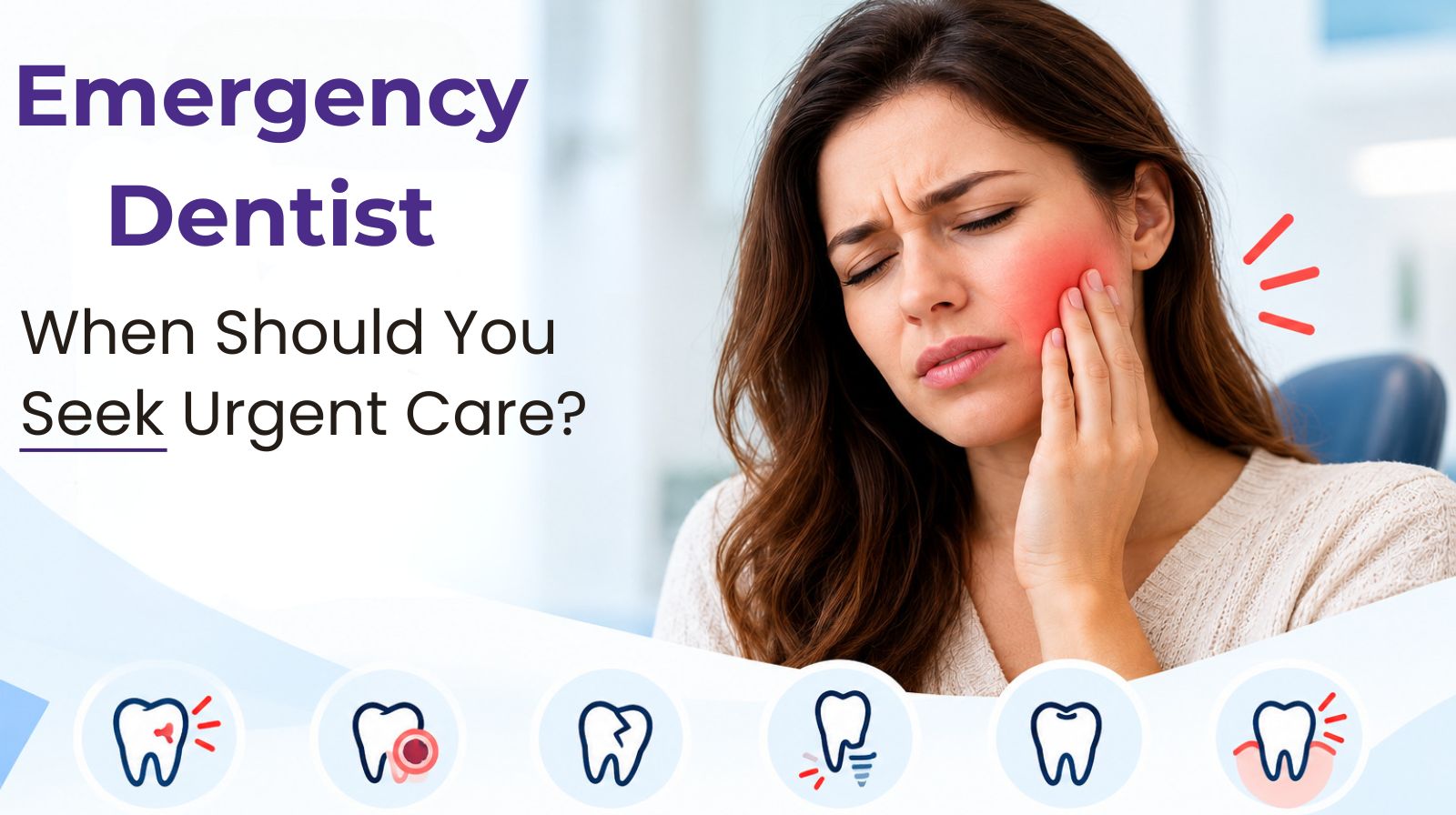
If you’re in pain right now, here’s the short version: get in touch with a dental practice straight away if the pain is severe, if there’s swelling, or if a tooth has been knocked out or broken. If you’ve got serious facial swelling that’s affecting your breathing or swallowing, or bleeding that won’t stop, that’s not a dental problem anymore. It’s a medical one. Go to A&E or call 999.
For everything short of that, this guide walks through how to tell what’s actually urgent, what you can do in the meantime, and what to expect once you’re in the dentist’s chair.
What Actually Counts as a Dental Emergency
“Emergency” gets thrown around a lot online, and it’s not always helpful. Not every chip, twinge or wobbly filling needs a same-day appointment. But some problems genuinely can’t wait, and putting them off tends to make things worse rather than better — infections in particular don’t just go away on their own.
A useful way to think about it:
- Needs seeing today or as soon as possible because waiting risks making it worse, or the pain simply isn’t manageable.
- Can wait for a routine appointment annoying, uncomfortable, but not clinically urgent.
- Needs A&E or 999, not a dentist when the problem has moved beyond the tooth itself, into breathing or bleeding that won’t stop.
Most of the calls a dental practice gets fall into that first category, and that’s what the rest of this article is really about.
When to See an Emergency Dentist in Herne Bay
Get in touch for an urgent appointment if you’re dealing with:
- Severe, persistent toothache that painkillers aren’t touching
- A dental abscess a swollen, painful infection around a tooth or in the gum
- Facial or mouth swelling that isn’t rapidly getting worse or affecting your breathing
- A broken, cracked or badly damaged tooth
- A knocked-out permanent tooth
- Bleeding that’s heavier than usual but manageable with pressure
- Wisdom tooth pain or swelling
- A lost filling that’s left a tooth exposed and sore
- A damaged crown, bridge or veneer that’s painful or sharp
- Any dental trauma from a fall, sport, or accident
If any of that sounds familiar, don’t spend too long trying to work out exactly which box it fits into just get seen. A dentist can sort out the “how urgent is this really” question far better once they can actually look at it.
Common Dental Emergencies and What to Do About Each One
Severe or sudden toothache
Persistent, intense pain that doesn’t ease off with paracetamol or ibuprofen especially if it’s keeping you up at night, or flares up with hot, cold, or biting pressure.
In the meantime: take the recommended dose of paracetamol or ibuprofen if they’re suitable for you, rinse gently with warm salt water, and steer clear of very hot, cold or sugary food and drink.
Skip the temptation to put aspirin directly on the gum it doesn’t actually relieve pain and can burn the tissue. Heat on the outside of your face isn’t a good idea either, as it can make swelling worse if there’s an infection underneath.
Get seen if: the pain is severe, painkillers aren’t working, or there’s swelling, a bad taste, or a temperature alongside it.
Dental abscess
A swollen, tender area on the gum sometimes with a visible lump, throbbing pain, soreness when biting, and occasionally a raised temperature or swollen glands.
This is a bacterial infection, not something that settles down by itself. Rinse with warm salt water a few times a day, take appropriate pain relief, and avoid chewing on that side. Don’t try to drain it yourself.
Get seen if: always, really even if the pain feels manageable, the infection itself needs treating.
Broken, chipped or cracked tooth
Could be a small chip or a tooth broken right down, usually from biting something hard or a knock. Rinse with warm water, keep hold of any fragments if you can find them, and cover sharp edges with sugar-free gum or dental wax to protect your cheek and tongue. Avoid chewing on that side, and resist the urge to file down a sharp edge yourself.
Get seen if: there’s pain, sensitivity, exposed nerve, or a sharp edge cutting into your mouth. A painless cosmetic chip can usually wait for a routine visit.
Knocked-out (avulsed) tooth
This is one of the rare dental problems where minutes genuinely matter. NHS guidance is specific about it:
- Pick the tooth up by the crown the white part never the root.
- If it’s dirty, rinse it gently in milk, saline or your own saliva. No scrubbing, no soap.
- Try to pop it back into the socket and bite gently on a clean cloth to hold it there.
- Can’t get it back in? Store it in milk (or, for an adult, in your cheek) and head straight to a dentist.
Don’t try to reimplant a baby tooth take your child to a dentist instead. The sooner an adult tooth goes back in, the better its chances, so this really is a “go now” situation rather than a “see how it feels” one.
Lost filling or damaged crown, bridge or veneer
A sudden gap where a filling used to be, or a crown, bridge or veneer coming loose or falling out. Hang onto it if you still have it it can sometimes be refitted. Avoid chewing on that side, and cover any sharp edge with sugar-free gum or dental wax.
Get seen if: it’s painful or sensitive, or there’s a sharp edge bothering you. A loose veneer with no pain can usually wait, though it’s worth a quick call to check.
Wisdom tooth pain
Pain, swelling or tenderness at the back of the jaw, sometimes with trouble opening your mouth fully usually a sign a wisdom tooth is partially through and irritated. Warm salt water rinses, pain relief, and gentle brushing around the area help in the short term.
Get seen if: there’s swelling, you’re struggling to open your mouth, or the pain is severe all signs of infection rather than simple irritation.
Bleeding gums or mouth
Heavier or more persistent bleeding than the usual bit after brushing say, following an injury or after a dental procedure. Apply firm, steady pressure with clean gauze for 15–20 minutes without repeatedly checking on it, and sit upright rather than lying down.
Get seen if: it’s still bleeding after 15–20 minutes of firm pressure. If it’s heavy and won’t stop at all, that’s an A&E situation more on that below.
When You Should Go to A&E Instead of a Dentist
This is the one distinction worth getting exactly right. Based on NHS guidance on emergency and out-of-hours dental care, head to A&E or call 999 if you have:
- A serious injury to your face or jaw
- Heavy bleeding from your mouth that won’t stop
- Swelling of your mouth, lips, throat or neck severe enough to affect breathing, swallowing, or opening your eyes
- Any head or facial injury that’s caused loss of consciousness, vomiting, or double vision
Don’t drive yourself if any of that applies get someone else to drive, or call 999 for an ambulance.
Everything else in this article toothache, abscesses, broken teeth, lost fillings, wisdom tooth pain, bleeding you can control — is a dental problem, not a medical one. Contact a dentist directly, or NHS 111 online if you don’t have a regular practice and aren’t sure which applies to you.
While You’re Waiting to Be Seen
- Paracetamol or ibuprofen, at the recommended dose, if they’re suitable for you
- Warm salt water rinse a teaspoon of salt in a glass of warm water
- Steer clear of very hot, cold or sugary food and drink
- Avoid chewing on the affected side
- Keep hold of any broken pieces, fillings or restorations
- Prop your head up a little if lying flat makes the throbbing worse
These help with the symptoms, not the underlying problem if things are severe or getting worse, don’t wait around to see if home measures are enough.
How Emergency Dental Treatment Works
Every case is different, but emergency appointments tend to follow a similar shape: the dentist assesses the problem (often with an X-ray), works out what’s actually causing it, manages pain or infection where needed, and either treats it there and then or stabilises it with a temporary fix until a follow-up visit. What happens next depends entirely on your situation your dentist will talk you through the options rather than just deciding for you.
How Warwick Lodge Dental Can Help
Warwick Lodge Dental & Implant Centre offers emergency dental treatment from our Herne Bay practice at 44 Canterbury Road. Severe toothache, an abscess, a broken or knocked-out tooth, bleeding gums, a lost filling or a damaged veneer call us and our team will aim to get you seen as quickly as possible.
Dental pain rarely picks a convenient moment, and emergency visits can be stressful in their own right which is part of why we welcome nervous patients as standard practice, not a special accommodation. And if cost is on your mind on top of everything else, our fees and finance page lays out how payment works, so there’s one less unknown.
If your emergency turns out to need something more involved a surgical extraction, for instance we’ll talk you through it rather than spring it on you.
To book or ask a question first, get in touch with our team.