
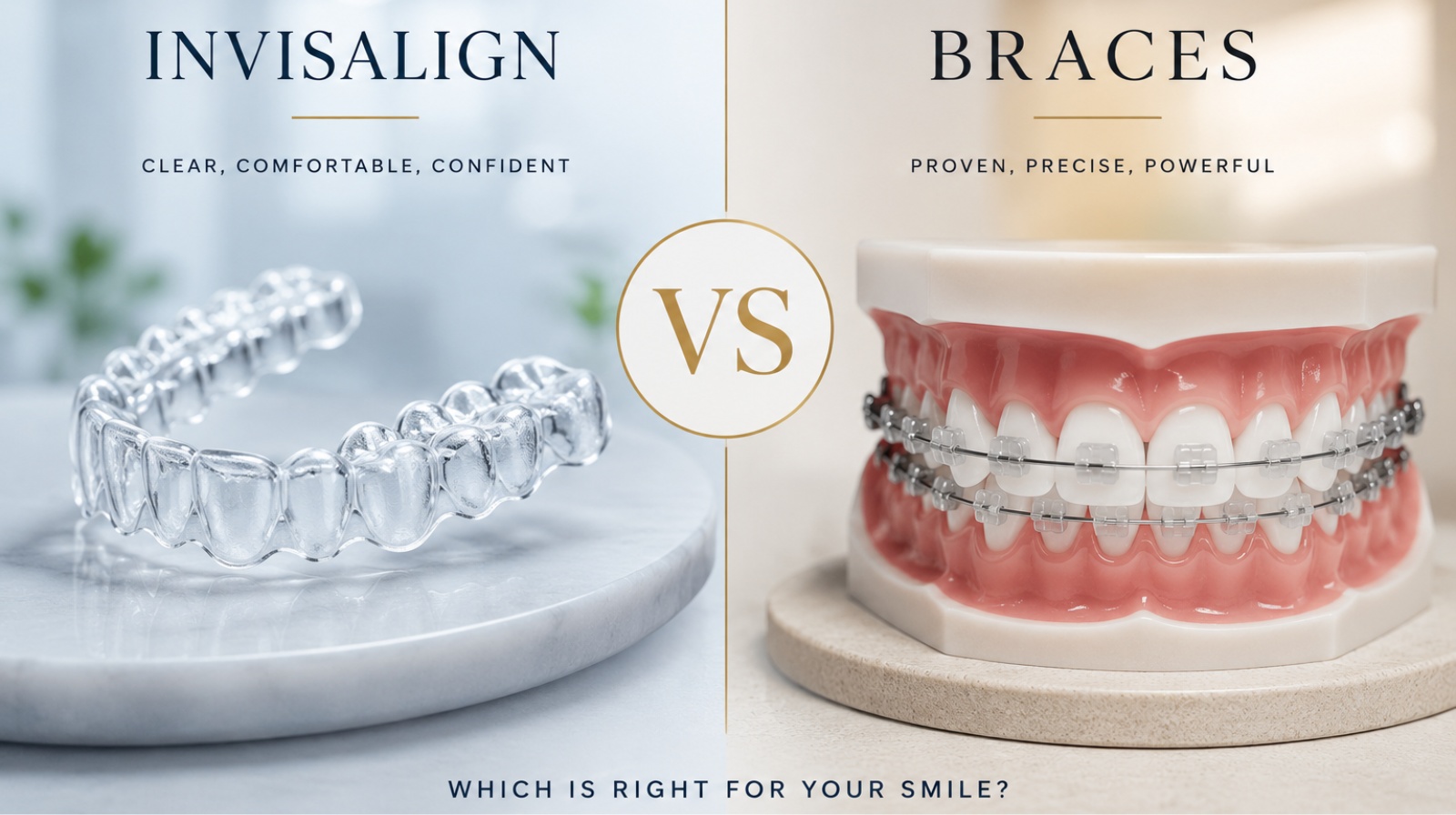
Is Invisalign better than braces for adults?” It’s one of the most searched questions in UK dentistry, and it deserves a better answer than most people find online.
Because the honest answer isn’t Invisalign, and it isn’t braces either. It depends, and understanding what it depends on is exactly what this guide is for. We’ll walk you through every meaningful difference between the two treatments, from how they look and feel day-to-day to what they cost and which cases each one handles best.
By the end, you won’t just know the options. You’ll know which one sounds right for you.
Now, let’s get into the comparison.
What Is Invisalign?
Invisalign is a clear aligner system that uses a series of custom-made, transparent plastic trays to gradually move your teeth into their ideal position. Each set of aligners is worn for one to two weeks before you move on to the next in the series.
They’re virtually invisible, removable when you eat or drink, and are designed using 3D digital scans of your teeth, no messy impressions needed. The system has been used by over 17 million patients worldwide and has advanced significantly since its early days, with AI-guided treatment planning and improved materials making today’s aligners more precise and comfortable than ever.
What Are Traditional Braces?
Traditional fixed braces use metal or ceramic brackets bonded to the surface of your teeth, connected by an archwire that applies gentle, consistent pressure to shift teeth over time. Every few weeks, your dentist adjusts the wire to continue the movement.
Modern braces have come a long way from the “train track” look of a decade ago. Today’s options include:
- Metal braces: the most effective and typically most affordable fixed option
- Ceramic braces: tooth-coloured brackets that blend in more naturally
- Lingual braces: fitted to the inside of the teeth, completely hidden from view
- Self-ligating braces: a refined design that reduces friction and can speed up treatment
Key Comparison: Invisalign and Braces
A dental bridge is a fixed restoration used to replace one or more missing teeth by literally “bridging” the gap with an artificial tooth, known as a pontic. The bridge is anchored onto the neighbouring healthy teeth using crowns. Once fitted, a bridge is permanent, it does not come in and out like a denture.
1. Appearance
Let’s be honest, for most adults considering orthodontics, this is where the conversation starts.
Invisalign aligners are made from a smooth, clear plastic that fits snugly over your teeth. Unless someone is very close and looking carefully, they’re almost impossible to spot. For professionals who present in meetings, see clients face-to-face, or simply feel self-conscious about the idea of “having braces as an adult,” this discretion is a genuine game-changer.
Traditional metal braces are visible — full stop. Ceramic braces reduce that visibility considerably, and lingual braces eliminate it (though lingual braces come at a significantly higher cost, typically £5,000–£7,000). If you opt for standard fixed braces, you’ll be making a visible commitment for the duration of your treatment.
Winner for aesthetics: Invisalign, though lingual braces are an honourable exception if budget allows.
2. Comfort
Invisalign aligners are smooth with no sharp edges, no wires, and no brackets. Most patients experience mild pressure when they first put in a new tray — a sign the teeth are moving — but this typically fades within a day or two.
Fixed braces come with the well-known adjustment period: soreness after each tightening appointment, occasional irritation from brackets rubbing against the inside of your cheeks, and the odd broken wire. It’s manageable, but it’s a different experience.
Winner for comfort: Invisalign, for most patients.
3. Effectiveness
This is where things get more nuanced — and where the honest answer is it depends on your case.
For mild to moderate alignment issues — crowding, spacing, minor overbite or crossbite — Invisalign achieves excellent results that are clinically comparable to braces. Research consistently shows the two treatments deliver similar outcomes for these everyday cases.
For more complex issues — significant bite correction, severe rotation, or cases requiring tooth extraction — traditional fixed braces offer a greater degree of mechanical control. They’re anchored to your teeth and work continuously, whereas aligners can only do what physics allows through removable trays.
One large study found that Invisalign averaged around 18 months of treatment compared to 24 months for traditional braces. However, this partly reflects the fact that Invisalign tends to be used for simpler cases, which naturally resolve faster. When researchers compared like-for-like cases, the gap narrowed considerably.
The bottom line: for the majority of adults with typical alignment concerns, Invisalign is highly effective. For complex cases, your dentist may recommend fixed braces to achieve the best possible result. This is a conversation worth having at your consultation — and it’s exactly why the assessment matters.
Winner for effectiveness: depends on case complexity. Fixed braces for complex; Invisalign for mild-to-moderate.
4. Lifestyle and Convenience
This is where Invisalign truly shines for adults.
Because the aligners are removable, you eat exactly what you want. With fixed braces, there’s a list of foods to avoid: hard nuts, crusty bread, sticky sweets, and raw carrots because they can dislodge brackets or snap wires.
Oral hygiene is also significantly easier with Invisalign. You simply remove the aligners to brush and floss as normal, then rinse the trays before putting them back in. With fixed braces, cleaning around brackets and under wires requires more time and specific tools. And if you don’t do it thoroughly, the risk of white spot lesions (early tooth decay around brackets) increases.
The trade-off? Invisalign requires discipline. The aligners must be worn for 20 to 22 hours every day to work. That means they go back in after every meal, every coffee, every snack. If you’re not wearing them, they’re not working. Patients who struggle with this commitment tend to extend their treatment unnecessarily — or see suboptimal results.
Winner for lifestyle: Invisalign, provided you’re committed to wearing them consistently.
5. Number of Appointments
Invisalign typically requires fewer in-person visits than traditional braces. Because you’re changing your aligners at home every one to two weeks, many of your progress checks can be spaced further apart — particularly useful if you travel, work long hours, or simply dislike time in the chair.
Fixed braces require adjustment appointments roughly every six to eight weeks throughout the full treatment period. This is manageable for most people, but worth factoring into your schedule.
Winner on appointments: Invisalign.
Who Is Invisalign Best For?
Invisalign is likely the right choice if you:
- Have mild to moderate crowding, spacing, or bite issues
- Work in a client-facing role or professional environment
- Prioritise discretion and don’t want your orthodontic treatment to be visible
- Have good self-discipline and will commit to wearing aligners 20–22 hours daily
- Want flexibility around eating and oral hygiene
- Travel regularly or prefer fewer dental appointments
Who Might Be Better Suited to Fixed Braces?
Fixed braces may be the stronger recommendation if you:
- Have a complex case involving significant bite correction or severe crowding
- Have struggled to commit to daily routines (aligners require consistent self-management)
- Are looking for the most cost-effective solution for a more involved case
- Prefer not to think about it — braces work whether you remember them or not
Ready to Find Out Which Option Is Right for You?
At Warwick Lodge Dental and Implant Centre, we take the time to fully assess your teeth, bite, and oral health before making any recommendations. We use 3D digital scanning to map your teeth precisely. We recommend the treatment that’s right for your teeth and your life.
We offer free consultations at Warwick Lodge for patients interested in Invisalign or teeth straightening. There’s no pressure, no obligation — just an honest conversation about what’s possible for your smile.
Book your consultation today and take the first step towards the teeth you’ve always wanted.