
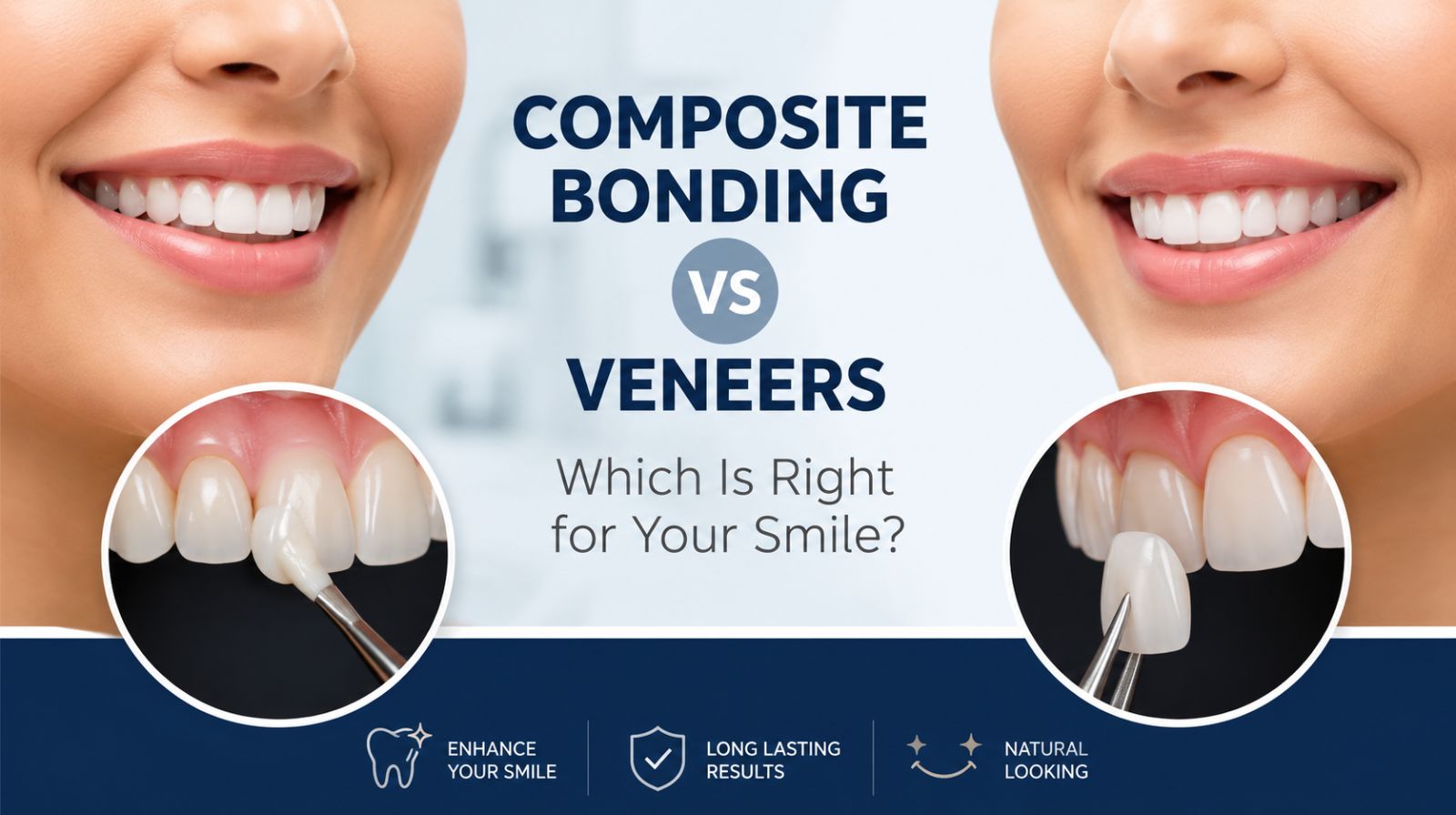
If you’re unhappy with the appearance of your teeth, you may have come across two popular cosmetic dentistry treatments: composite bonding and porcelain veneers.
Both can improve the shape, colour and overall appearance of your smile, but they work in different ways and are not suitable for exactly the same situations. Choosing between composite bonding and veneers is therefore not simply about deciding which treatment looks better. It is about finding the option that fits your teeth, your goals and your long-term expectations.
So, which is better: composite bonding or veneers?
The answer depends on what you want to change and the condition of your teeth.
In this guide, we explain the key differences between composite bonding and porcelain veneers, including appearance, durability, tooth preparation, treatment time and the types of cosmetic concerns each treatment can address.
What Is Composite Bonding?
Composite bonding is a cosmetic dental treatment that uses a tooth-coloured composite resin to alter or repair the appearance of a tooth.
During treatment, the dentist applies the composite material directly to the tooth before carefully shaping, hardening and polishing it. The material can be colour-matched to your existing teeth to create a natural-looking result.
Because the composite is applied directly to the tooth, your dentist can use it to make relatively small changes to the shape and proportions of individual teeth.
Composite bonding can be used to:
- Repair small chips and minor cracks
- Improve the shape of uneven or worn teeth
- Close some small gaps between teeth
- Make teeth appear more even
- Improve certain areas of discolouration
- Build up teeth that appear short or irregular
- Create a more balanced overall smile
One of the main advantages of composite bonding is that it is generally a minimally invasive treatment. In suitable cases, little or no healthy enamel needs to be removed.
At Warwick Lodge Dental, composite bonding can typically be completed in a single appointment, with the treatment taking around 30–60 minutes per tooth depending on the individual case.
However, composite bonding is not as resistant to wear and staining as porcelain, and it may eventually require polishing, repair or replacement. Warwick Lodge states that composite bonding can last around 7–10 years with appropriate care, although the actual lifespan varies between patients.
What Are Porcelain Veneers?
Porcelain veneers are thin, custom-made shells designed to cover the visible front surface of a tooth.
Rather than adding composite resin directly to the tooth, a veneer is individually designed to achieve the desired shape, size and colour before being bonded to the tooth.
Porcelain is particularly popular in cosmetic dentistry because it can provide a highly realistic appearance and is naturally resistant to staining.
Veneers can be used to improve several cosmetic concerns, including:
- Discoloured teeth that do not respond well to whitening
- Chipped or worn teeth
- Uneven tooth shapes
- Small gaps between teeth
- Minor irregularities in tooth position
- Teeth that appear too small or disproportionate
- Overall smile aesthetics
Warwick Lodge offers porcelain veneers as part of its cosmetic dentistry treatments. The practice describes porcelain veneers as thin, strong and stain-resistant, with a potential lifespan of around 10–15 years or more with appropriate maintenance and care.
However, porcelain veneers normally require some preparation of the natural tooth to accommodate the veneer. This means they are a more involved treatment than composite bonding and should be considered carefully with your dentist.
Composite Bonding vs Veneers: What’s the Difference?
Although both treatments can improve your smile, there are several important differences between composite bonding and porcelain veneers.
| Feature | Composite Bonding | Porcelain Veneers |
|---|---|---|
| Material | Composite resin | Porcelain/ceramic |
| Application | Applied directly to the tooth | Custom-made shell bonded to the tooth |
| Tooth preparation | Usually minimal | Usually requires some enamel preparation |
| Treatment time | Often completed in one visit | Usually takes more than one appointment |
| Appearance | Can look very natural | Highly natural and lifelike |
| Stain resistance | More susceptible to staining | Highly stain-resistant |
| Durability | Good, but more prone to chipping/wear | Generally more durable |
| Repairs | Often relatively straightforward | May require replacement if damaged |
| Longevity | Often around 7–10 years, depending on care and circumstances | Around 10–15 years or more with appropriate care, according to Warwick Lodge |
These are general comparisons rather than guarantees. The best treatment for you will depend on your individual teeth, oral health, bite and desired result.
Which Looks More Natural?
Both composite bonding and porcelain veneers can produce natural-looking results when carefully planned and carried out by an experienced dental professional.
The final appearance is influenced by much more than the material itself.
Factors such as tooth colour, shape, proportions, translucency, texture and how the restoration interacts with your surrounding teeth all contribute to a natural-looking smile.
Porcelain has an advantage when it comes to reproducing some of the optical qualities of natural enamel. It can reflect and transmit light in a way that closely resembles natural teeth, while also maintaining its appearance over time.
Composite bonding, however, can also be highly aesthetic. Because the dentist shapes the material directly on the tooth, it allows a high degree of control over the final contours.
For smaller cosmetic changes, composite bonding can provide an excellent and conservative result without the need for extensive treatment.
The most natural-looking option is not necessarily the most expensive option. Good planning, appropriate case selection and careful attention to detail are crucial with either treatment.
Which Treatment Is More Durable?
When comparing composite bonding vs porcelain veneers, durability is one of the biggest differences to consider.
Porcelain is generally harder and more resistant to staining than composite resin. This makes porcelain veneers a popular choice for patients looking for a longer-term cosmetic solution.
Composite bonding can also be durable, but the material is more susceptible to chipping, surface wear and staining over time, particularly if you regularly bite hard foods, grind your teeth or have habits such as biting your nails.
This does not mean that bonding is a short-term treatment. With good oral hygiene, regular dental care and sensible habits, it can last for many years.
Warwick Lodge states that composite bonding may last around 7–10 years with proper care, while porcelain veneers can last around 10–15 years or more.
It is important to remember that these figures are estimates rather than guarantees. Your individual bite, oral hygiene, lifestyle and maintenance all influence how long a cosmetic restoration lasts.
Which Is More Suitable for Chipped Teeth?
For a small chipped tooth, composite bonding is often an attractive option.
The dentist can add composite resin to the affected area and carefully recreate the missing section of the tooth. Because relatively little tooth preparation may be needed, bonding can be a conservative way of restoring the appearance of a minor chip.
This is particularly useful when the underlying tooth is healthy and the damage is limited.
Porcelain veneers may also be appropriate for chipped teeth, particularly when there are additional cosmetic concerns such as significant discolouration, uneven tooth shape or several teeth that need to be redesigned as part of a wider smile makeover.
However, not every chipped tooth should automatically be treated with bonding or a veneer.
If a tooth has significant structural damage, decay, a deep crack or problems affecting the nerve, a different restorative treatment may be more appropriate.
This is why a dental assessment should come before deciding on cosmetic treatment.
How Long Does Each Treatment Take?
Treatment time depends on the number of teeth being treated and the complexity of your case.
Composite bonding
One of the major advantages of composite bonding is speed.
At Warwick Lodge, composite bonding typically takes around 30–60 minutes per tooth and can often be completed during a single appointment.
The dentist applies the composite, shapes it, hardens it with a curing light and then polishes the finished restoration.
For a patient having a small number of teeth treated, this can make composite bonding a convenient option.
Porcelain veneers
Porcelain veneers generally take longer because each veneer needs to be carefully planned and custom-made.
The process can involve an initial consultation and assessment, tooth preparation and impressions or digital scans, followed by the manufacture and fitting of the veneers.
Warwick Lodge explains that veneer treatment is typically completed over two appointments.
Your dentist will explain the exact process and timescale based on the number of veneers you are considering.
Composite Bonding vs Veneers: Which Is More Suitable for You?
There is no single answer to the question “Are veneers better than composite bonding?”
The right treatment depends on your individual circumstances.
Composite bonding may be suitable if:
- You have small chips or minor imperfections
- You want a conservative cosmetic treatment
- You want to make relatively small changes to tooth shape
- You have small gaps that could be cosmetically closed
- You prefer a treatment that can often be completed in one visit
- You want to preserve as much natural tooth structure as possible
Porcelain veneers may be suitable if:
- You want to make more comprehensive cosmetic changes
- You have significant discolouration that whitening may not resolve
- Several teeth need changes to their shape or proportions
- You want a highly stain-resistant restoration
- You are looking for a longer-lasting cosmetic option
- You understand that veneer treatment usually involves some tooth preparation
There is also no reason to assume that every tooth in a smile needs exactly the same treatment. Depending on your goals, a dentist may recommend a combination of cosmetic treatments to achieve a balanced result.
Why Choose Warwick Lodge Dental in Herne Bay?
Choosing cosmetic dental treatment is about more than selecting a material. Your dentist needs to understand your expectations, assess your oral health and consider how the proposed treatment will work with your natural teeth and bite.
At Warwick Lodge Dental & Implant Centre in Herne Bay, Kent, cosmetic and restorative dentistry is provided under one roof. The practice offers treatments including composite bonding, dental veneers, teeth whitening, Invisalign and smile makeovers.
If you are unsure whether composite bonding or porcelain veneers would be right for you, a consultation can help you understand the options available and what can realistically be achieved.